|
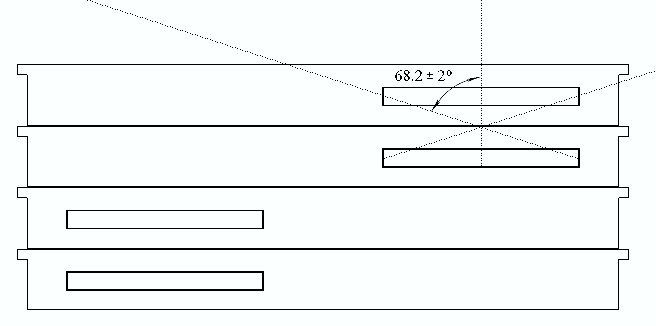
The MUD experiment includes two detector units both consisting of three pairs
of vertically overlapping plastic scintillators, each equipped with standard
NIM electronics and a personal computer for data storage. Each of the 12
counters have 0.50 m x 0.50 m scintillation plastic. Hence the setup
constitutes 1,5 m2 total area. The equipment has proviously been
used in the MUG experiment. All the equipment has been placed in a trailer,
which can be easily moved around the mine by car. Computers save event
times and pulse heights of all the hits that occur simultaneously in two
overlapping counters. Counting rates are calculated from these data
files. Following figure shows the arrangement of the counters and their
measurement angles.
Data acquisition
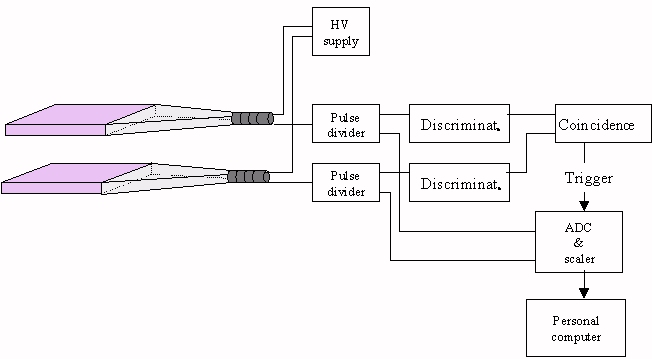
A data acquisition unit designed and manufactured by Detection Technology Inc
is used for data recording and pulse height AD-conversion.
- Standard NIM electronics: two discriminator (Ortec 928, CAEN N413A)
and two coincidence (LeCroy 622) units.
- 8-bit ADC & Scaler unit designed and manufactured by
Detection Technology Inc. Units are
adjusted to record pulse heights corresponding to 1 - 8 simultaneous minimum
ionising particles, i.e. muons.
- High voltage supplies partly commercial (Bertan) with home-made voltage
dividers or home-made integrated high-voltage supply & divider units
- Two Intel Pentium computers for data storage (450 MHz CPUs and 2 Gbyte
hard disks)
- UPS back-up securing data collection in case of passing mains drifts or
cut-offs.
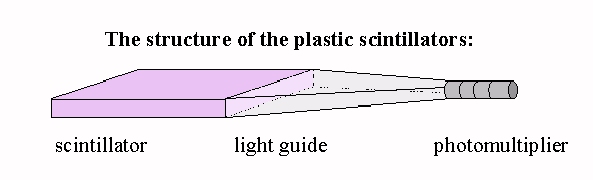
Scintillation detectors
- Scintillation plastic NE102A, maximum light output at 423 nm, size 0.50 m
x 0.50 m x 0.05 m.
- Fishtail-shaped acrylic light guides.
- Optical grease BC-630 as optical connector.
- Scintillator housing water- and light-tight stainless steel boxes,
size 1.60 m x 0.75 m x 0.15 m.
- Total weight with housing app. 60 kg.
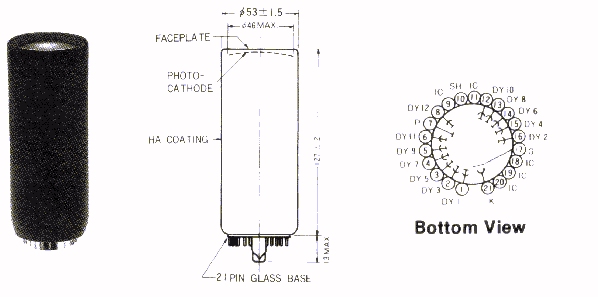
Photomultipliers Hamamatsu R329-02
- Head-on type, 12 dynode stages.
- Circular borosilicate window with diameter 51 mm.
- Semitransparent bialkali photocathode, quantum efficiency ~25 %.
- m-metal magnetic shielding.
- Fast time response: pulse rise time typically 2.6 ns.
- Sensitivity range 300 nm - 600 nm, peak wavelength 420 nm.
- Cathode-to-anode voltage typically 1.7 kV - 2.1 kV.
- Negative polarity output pulses, 50 W impedance.
|